The Real Reason Your Workout Earbuds Drain Faster Than the Battery Spec Promises
Quick Answer: Advertised earbud battery life is typically measured at moderate, fixed volume in ideal conditions - real workout use involves higher volume (to overcome gym noise or wind), Bluetooth connection strain from movement, and temperature effects from body heat, all of which meaningfully reduce actual battery life below the advertised number. Lowering volume slightly and keeping earbuds in a stable connection range closes most of this gap.
The battery spec on the box said 6 hours, but a real workout routine seems to drain them in 4 - the gap isn’t a defect, it’s a difference between lab testing conditions and actual workout conditions.

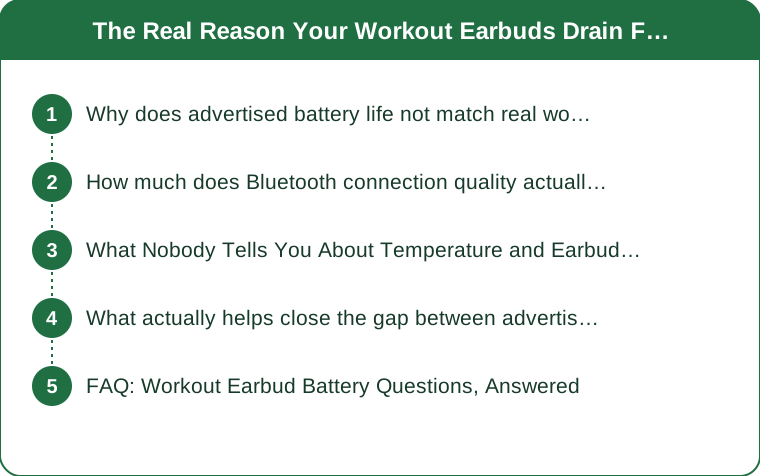
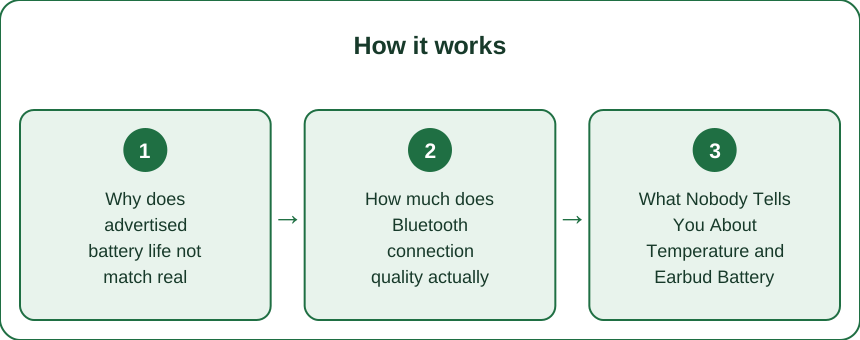
Why does advertised battery life not match real workout usage?
Battery life specs are typically tested at around 50-60% volume in a stable, interference-free Bluetooth environment - real workout conditions usually involve higher volume (to hear music over gym equipment noise or outdoor wind) and more Bluetooth signal strain from arm and head movement, both of which increase power draw meaningfully compared to the test conditions.
Higher volume alone can reduce battery life by a notable margin compared to the tested moderate-volume baseline, and this is often the single biggest factor separating advertised life from real workout life, more so than any other individual variable.
How much does Bluetooth connection quality actually affect battery drain?
When earbuds have to work harder to maintain a stable Bluetooth connection - due to your phone being farther away in a pocket during running, or body position blocking the signal path - they draw more power re-establishing and maintaining that connection compared to a stable, close-range connection. This is a less obvious factor than volume but still meaningfully contributes to workout-specific battery drain.
Keeping your phone in an armband or a position with a clearer signal path to your ears, rather than in a back pocket during exercise involving a lot of movement, can measurably help battery life by reducing this connection strain.

What Nobody Tells You About Temperature and Earbud Battery Life
Here’s a factor most battery advice skips entirely: body heat and sweat exposure during workouts can affect battery performance in true wireless earbuds, since lithium-ion batteries generally perform somewhat less efficiently at higher temperatures than the cooler conditions typical of standard lab battery testing. This effect is usually modest individually but combines with the volume and connection factors above to compound the real-world battery gap.
The other overlooked detail: frequent case removal and reinsertion during a single workout (checking notifications, adjusting fit repeatedly) can prevent earbuds from ever reaching a stable low-power state between uses, since each removal triggers a reconnection process that itself draws power - minimizing unnecessary removal during a single session helps preserve battery somewhat.
What actually helps close the gap between advertised and real battery life?
Lowering volume even slightly from your default workout level is the single highest-impact change, given how much volume alone affects power draw. Keeping your phone in a position with a clear, close Bluetooth signal path (an armband rather than a back pocket, for high-movement workouts) reduces connection-related drain.
Fully charging the case before workouts and avoiding letting earbuds sit at very low charge for extended periods also helps maintain more consistent performance over the earbuds’ longer lifespan, since batteries generally perform better when not repeatedly depleted to very low levels.
FAQ: Workout Earbud Battery Questions, Answered
Do noise-cancellation features affect battery life during workouts?
Yes, active noise cancellation draws additional power on top of playback and Bluetooth connection, so disabling it during workouts (where ambient awareness is often preferable anyway) can meaningfully extend battery life.
Does earbud battery life advertised for casual use apply differently to running versus strength training?
Somewhat - running typically involves more Bluetooth connection strain due to more body and arm movement, while strength training with less continuous movement tends to be closer to standard advertised conditions.
Will earbud battery capacity naturally decline over time regardless of usage habits?
Yes, like all lithium-ion batteries, gradual capacity decline over months and years of charge cycles is normal and expected, separate from the workout-specific drain factors discussed here.
TL;DR:
- Advertised battery life is tested at moderate volume in stable conditions, not real workout conditions
- Higher volume and Bluetooth connection strain from movement are the biggest real-world drain factors
- Body heat and frequent case removal during a workout compound the gap further
- Slightly lower volume and a stable phone position close most of the difference
The battery gap between the box and your actual workout isn’t a sign something’s wrong - it’s the predictable difference between lab testing conditions and real movement, noise, and connection demands.
Keep Reading
This article is for general informational and styling purposes only. Fit, sizing, and product availability may vary.