Foam or Silicone Tips: Which Actually Stays In During a Workout?
Quick Answer: Foam tips grip better and seal better, which means fewer falls and better bass - but they absorb sweat, degrade in two to three months, and get uncomfortable on long sessions. Silicone tips are easier to clean, last far longer, and handle sweat properly, but they slip once wet. For most workouts, silicone in a correctly matched size beats foam in the wrong size, and getting the size right is worth more than the material choice. For running in heat, foam usually wins on retention. For gym sessions and anything over an hour, silicone usually wins on comfort and hygiene.
People spend a long time choosing earbuds and almost no time on the small rubber part that determines whether they stay in your ear.
Which is backwards. The tip decides retention, seal, sound quality and comfort, and it is the one component you can change for a few pounds.
The two materials are genuinely different tools, and the choice depends more on what you do and how much you sweat than on which is objectively better.

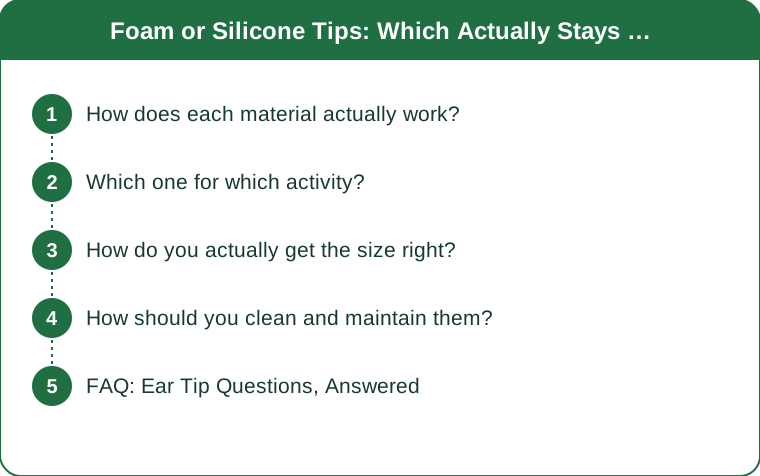
How does each material actually work?
They achieve a seal by opposite mechanisms, which is why they fail differently.
Silicone tips seal by shape. A flexible dome presses outward against the ear canal wall. Fit depends entirely on the dome matching your canal - too small and there is a gap, too large and it will not seat properly and pushes back out.
Foam tips seal by expansion. Memory foam is compressed between your fingers, inserted, and then expands to fill whatever shape the canal is. That conformity is why foam works for irregular canals, which are far more common than the tip sizes on offer suggest.
The consequences follow directly:
Foam grips better. Larger contact area and outward pressure against the canal wall. This is why foam is the standard fix for earbuds that fall out.
Foam seals better, which improves bass response and passive noise isolation noticeably. The same earbud can sound like a different product with a proper seal.
Silicone is non-porous. It does not absorb anything - not sweat, not earwax - so it wipes clean and lasts.
Foam is porous. It absorbs sweat and wax, which is exactly the problem in a workout context. Foam tips are consumables, typically lasting two to three months with regular gym use, and less if you sweat heavily.
And the heat point that decides a lot of cases: foam absorbs sweat, and saturated foam loses its expansion properties. Foam that starts the run gripping well can be noticeably worse at forty minutes on a warm day.
Which one for which activity?
The activity matters more than the material preference, and the split is fairly clean.
Running and high-impact - foam usually wins. Repeated impact is the main cause of earbuds working loose, and foam’s grip is the best defence. The exception is very hot, very sweaty running, where saturation may undo the advantage partway through. Worth testing on your own worst-case run rather than assuming.
Gym and weights - silicone usually wins. Less impact, so retention is a smaller problem, and sessions tend to be longer. Silicone’s comfort over time and its resistance to sweat matter more here. Being able to rinse the tips after a session and have them dry in twenty minutes is a genuine advantage.
Cycling - silicone, and consider open-ear designs. You need situational awareness on a road, and foam’s superior isolation is a safety negative rather than a positive.
Long sessions over an hour - silicone. Foam’s constant outward pressure becomes uncomfortable over time, and this is the most common complaint about foam by a distance. Ear canal discomfort at the ninety-minute mark is usually a foam problem.
Swimming and water - neither of these, you need purpose-built waterproof tips.
Hot yoga or anything very humid - silicone, without hesitation. Foam in high humidity absorbs moisture from the air as well as from you, and it will not dry between sessions.
The honest general answer: if you only want one set, silicone in the correct size covers most situations. Add a foam set specifically for running if retention is your problem.

How do you actually get the size right?
Size is more important than material, and most people are wearing the wrong size because they never changed from the default.
Manufacturers ship medium tips fitted. Medium fits roughly the middle of the distribution and is wrong for a substantial minority of people - and once they are in the box, most people never revisit it.
How to find the right size:
Start with the seal test. Insert the earbud and play music. A correct seal produces a noticeable drop in outside noise and a clear increase in bass. If it sounds thin and you can hear the room normally, the tip is too small.
Try one size up from your assumption. Most people under-size, because a slightly-too-small tip feels more comfortable initially and only reveals itself as a problem once you move.
Check each ear separately. Ear canals are frequently different sizes between left and right, and mismatched tips are a completely normal solution rather than a compromise. If one earbud always falls out and the other never does, this is almost certainly why.
Do the movement test. Chew, talk, turn your head, and jog on the spot for fifteen seconds. Jaw movement changes ear canal shape more than people realise, and a tip that only fits with your jaw still is not fitted.
5 mistakes people make with tips:
- Never changing from the default medium. The single most common issue in the whole category.
- Choosing based on initial comfort. The most comfortable tip on insertion is often too small, and it will drift out.
- Using the same size in both ears when the ears are different.
- Not replacing foam tips. They are consumables. After three months they have lost most of their expansion.
- Inserting foam wrong. Foam must be rolled and compressed between your fingers first, then inserted, then held for ten seconds while it expands. Pushing an uncompressed foam tip in does not work and is uncomfortable.
How should you clean and maintain them?
This is not a fastidiousness question - tips sit in a warm, moist, enclosed space, and the hygiene consequences are real.
Silicone, after every few sessions: remove from the earbud, wash in warm soapy water, rinse, and dry completely before refitting. Two minutes, and it is the reason silicone lasts a year or more.
Foam: you cannot really wash it. Wiping the surface removes some sweat and none of what has soaked in. Foam tips are consumables - replace every two to three months with regular workout use, sooner if you sweat heavily or notice the expansion getting slower.
After every workout, regardless of material: wipe the tips and let the earbuds air out before the case. Sealing damp earbuds into a charging case is the main cause of the moisture damage that kills them, and it is entirely avoidable.
Watch for the signs that it is time to replace: foam that no longer expands fully, foam that stays compressed after removal, silicone that has gone stiff or developed small tears, or any tip that has become discoloured in a way cleaning does not fix.
And the health point worth stating plainly: earbuds do increase the humidity and temperature of the ear canal, and dirty tips reintroduce bacteria every session. Ear irritation and outer ear infections are a genuine risk with poorly maintained tips, and they are much more common than people expect. If you get itching, discharge, or persistent discomfort, that is a doctor rather than a different tip.
FAQ: Ear Tip Questions, Answered
Do foam tips really improve sound quality?
They improve the seal, and the seal improves the sound - particularly bass, which drops off dramatically with any gap. The earbud is unchanged; what changes is how much of its output actually reaches your eardrum. A well-fitted silicone tip achieves the same thing, which is why size matters more than material for sound. If your earbuds sound thin, check the fit before you blame the earbuds.
Why does one earbud fall out and the other never does?
Because your ear canals are different sizes, which is extremely common and rarely accounted for. The fix is to use different tip sizes in each ear - buy a multi-size pack and mix them. It looks odd on paper and it solves the problem permanently, which is a better trade than continuing to push one earbud back in every four minutes.
Are third-party tips worth buying?
Often, yes, and they are one of the cheapest meaningful upgrades available. Third-party makers offer a wider size range and more material options than the two or three sizes in the box, and they are inexpensive. Check compatibility with your specific model first - the connection stem varies, and a tip that does not seat securely will come off in your ear, which is worse than any fit problem it solves.
General information, not medical advice. Ear pain, itching, discharge, or hearing changes should be assessed by a healthcare professional.
TL;DR:
- Foam grips and seals better, silicone is cleaner, more durable and more comfortable long-term.
- Size matters more than material. Most people are still wearing the default mediums and should not be.
- Different sizes in each ear is normal and is usually why one earbud keeps falling out.
- Running: foam, unless heat saturates it. Gym and long sessions: silicone. Cycling: silicone, for awareness.
- Foam tips are consumables - two to three months. Silicone gets washed and lasts a year.
It is a few pounds and five minutes, and it changes retention, comfort and sound more than the next earbud upgrade you were considering.
Keep Reading
This article is for general informational and styling purposes only. Fit, sizing, and product availability may vary.