Open-Ear or In-Ear Workout Earbuds — Which Trade-offs Actually Matter for You?
Quick Answer: Open-ear earbuds win on safety awareness (you can hear traffic and surroundings) and all-day comfort with zero ear canal pressure, while in-ear earbuds win on noise isolation, bass quality, and staying secure during high-impact movement — the right choice depends on whether you train outdoors around traffic or mainly indoors where isolation matters more.
Open-ear earbuds get marketed as the obvious upgrade, but they’re not a strict improvement — they trade away real things in-ear designs do well. The right pick depends on what kind of workouts you’re actually doing.
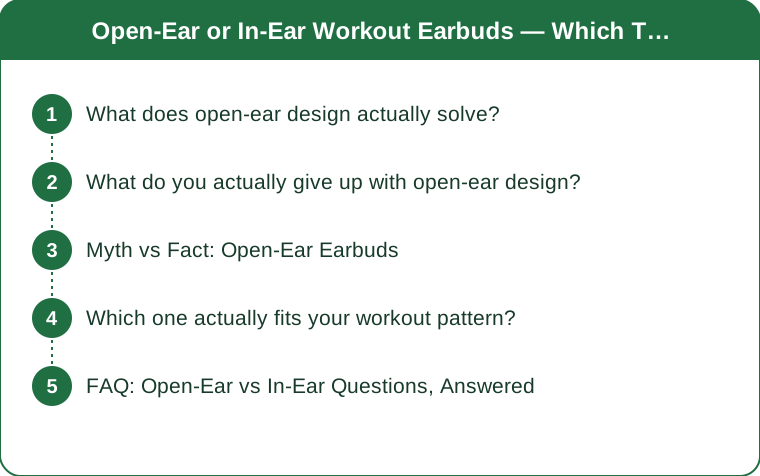
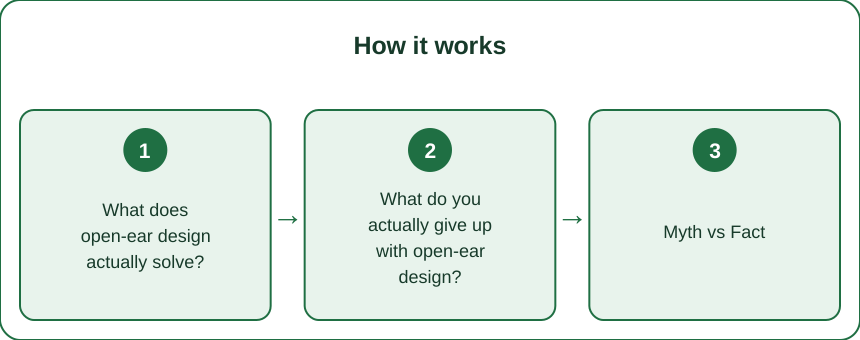
What does open-ear design actually solve?
Situational awareness is the core advantage — open-ear earbuds (bone-conduction or air-conduction designs that sit outside the ear canal) let you hear traffic, other runners, or someone calling your name, which matters significantly for outdoor running or cycling near roads.
They also eliminate ear canal pressure and moisture buildup entirely, which some people find meaningfully more comfortable for long sessions, and reduce the risk of ear infections associated with sealed in-ear designs during sweaty workouts.
What do you actually give up with open-ear design?
Sound quality, particularly bass, is measurably weaker than sealed in-ear designs, since there’s no ear canal seal to reinforce low frequencies — a real trade-off if audio quality matters to your workout experience.
Noise isolation is intentionally absent — great for outdoor safety, genuinely worse for gym environments with loud ambient noise, where you’ll likely need to turn volume up higher to compensate, partially offsetting the safety benefit in a different way.
Myth vs Fact: Open-Ear Earbuds
Myth: Open-ear earbuds are strictly safer for all workouts. Fact: They’re safer for awareness in outdoor, traffic-adjacent settings specifically — in a gym or indoor setting, the awareness benefit is largely irrelevant, and you’re just trading away sound quality for no real safety gain.
Myth: Open-ear earbuds don’t stay secure during high-impact workouts. Fact: Modern hook or clip designs generally stay secure through running and most HIIT movement — security concerns are more of an older-design issue than a current one.
Myth: Bone conduction and air conduction open-ear designs are the same thing. Fact: They use different mechanisms (vibration through bone vs. directed sound near the ear canal) with somewhat different sound profiles — worth testing both before assuming ‘open-ear’ is one uniform experience.
Which one actually fits your workout pattern?
- Mostly outdoor running or cycling near traffic: open-ear, for the awareness benefit alone
- Mostly gym or indoor training: in-ear, since isolation and sound quality matter more without a traffic safety concern
- Mixed environments: consider owning both, since the trade-off genuinely reverses by setting
- Long-duration comfort priority: open-ear tends to win for multi-hour wear without ear fatigue
FAQ: Open-Ear vs In-Ear Questions, Answered
Is open-ear objectively the newer, better technology?
Newer, yes — objectively ‘better’ depends entirely on use case; it solves different problems than in-ear rather than solving the same ones more effectively.
Do open-ear earbuds work well for swimming?
Generally no — most open-ear designs aren’t built for underwater use; check waterproof ratings carefully if that’s a use case.
Is the sound quality gap noticeable to a casual listener?
Most people notice reduced bass specifically, especially with music-heavy workouts — podcast or spoken-word content is less affected by the gap.
TL;DR:
- Open-ear wins on outdoor safety awareness and all-day ear canal comfort
- In-ear wins on noise isolation, bass quality, and gym-environment sound performance
- The right choice depends on training environment, not which design is objectively newer
- Mixed-environment athletes may genuinely benefit from owning both styles
Neither design is a strict upgrade — match the trade-off to where you actually train.
Keep Reading
This article is for general informational and styling purposes only. Fit, sizing, and product availability may vary.