Why Your Earbuds Sound Different When You Start Sweating
Quick Answer: Sweat breaks the acoustic seal between the ear tip and your ear canal, and bass is the first thing to go because low frequencies depend almost entirely on that seal. Three things cause it: moisture makes silicone tips slip, your ear canal changes shape slightly as you warm up and your jaw moves, and sweat film alters the friction between tip and skin. Active noise cancellation also degrades sharply with a broken seal, which makes the gym suddenly seem louder.
The first song sounds enormous. By song four it sounds like it is playing in the next room.

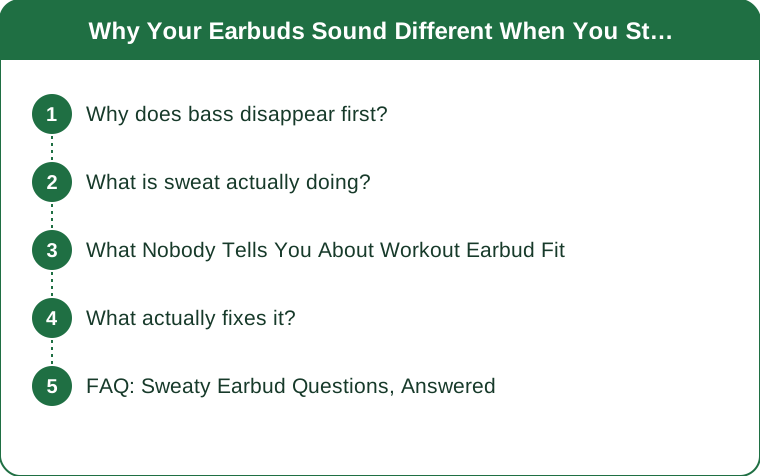
Why does bass disappear first?
Because low frequencies are the most seal-dependent part of audio reproduction, and a seal is easier to lose than to keep.
Bass needs a sealed chamber. Low frequencies are long waves that require pressure to build in the closed volume between the driver and your eardrum. Break the seal even slightly and the pressure escapes, taking the bass with it. Mid and high frequencies are far less dependent on this, which is why the sound goes thin and distant rather than simply quieter.
A gap of well under a millimeter is enough. This is why the effect seems so disproportionate - a tip that has slipped a barely perceptible amount produces a dramatic change in what you hear.
Noise cancellation collapses at the same time. ANC works by measuring outside noise and generating an inverse wave, and it assumes a sealed environment. A leak means the cancellation stops matching what actually reaches your eardrum. The gym getting louder and the bass getting thinner are the same event, which is why they always happen together.
Your brain then turns up the volume. The instinctive response is to raise the volume to compensate, which is the actual hearing-safety concern in this whole situation.
What is sweat actually doing?
Three separate mechanisms, and knowing which one is yours determines the fix.
It lubricates the contact surface. Silicone tips grip the ear canal by friction. A film of sweat reduces that friction, and the tip migrates outward with jaw movement and impact. This is the most common cause by a wide margin and the easiest to address.
Your ear canal changes shape. The canal is not a rigid tube - it deforms with jaw movement, and it swells slightly with increased blood flow as you warm up. A tip that fit perfectly at rest can fit differently 20 minutes into a run.
Salt residue builds up. Over multiple workouts, dried sweat leaves a residue on both the tip and inside your ear that changes surface texture. Tips that used to grip stop gripping, which is why the problem often worsens over weeks rather than staying constant.
And impact adds motion. Every foot strike transmits force up through the skull. Running and jumping dislodge tips far more than cycling or lifting, which is why the same earbuds can be fine in one workout and useless in another.

What Nobody Tells You About Workout Earbud Fit
Your two ears are different sizes. Most people have measurably different left and right ear canals, and nearly everyone uses matching tips on both. Mixing tip sizes - medium in one, small in the other - solves a surprising share of one-side-slips problems, and manufacturers include multiple sizes precisely because of this.
Foam tips beat silicone when you sweat. Memory foam expands into the canal rather than relying on friction against a wall, and it is far less affected by moisture. The tradeoff is that foam absorbs sweat, needs replacing every few months, and is slightly harder to clean.
Wing tips and fins address a different problem. They stop the whole bud from falling out; they do not maintain the acoustic seal. If your issue is bass loss rather than losing the earbud entirely, a wing tip will not fix it.
A haircut can change the fit. It sounds absurd and it is real for over-ear hook styles and for anyone whose hair sat between the bud and the ear.
The IP rating is about survival, not fit. IPX4 means it survives splashes. It says nothing about whether it stays sealed, and these are entirely separate questions that get conflated constantly.
Dirty tips genuinely sound worse. Earwax and residue in the mesh muffle high frequencies. If your earbuds sound dull generally, cleaning them is a free upgrade most people never perform.
What actually fixes it?
In rough order of effectiveness for the sweat-specific version of the problem.
1. Switch to foam tips. The highest-impact change if sweat is your issue. Compress, insert, and let them expand for a few seconds. They cost little and typically eliminate the mid-workout bass loss entirely.
2. Try mismatched sizes. Free, takes two minutes, and fixes the very common case where only one side slips.
3. Dry your ears before you start. If you are exercising in heat or after a warm-up, a quick pass with a towel before inserting makes the initial seal much more durable.
4. Reinsert with a twist rather than a push. Pull the top of your ear up and back with the opposite hand to straighten the canal, insert, then rotate slightly. This seats the tip deeper than a straight push, and depth is what resists migration.
5. Clean them weekly. Remove the tips, wash silicone ones in warm soapy water and dry fully, and brush the mesh gently with a dry soft brush. Salt and wax buildup is progressive, and so is the fit degradation it causes.
6. Consider whether you need a seal at all. For outdoor running, open-ear or bone conduction designs sidestep this entire problem - no seal to lose, plus better awareness of traffic. You give up bass response, which for a run is often an acceptable trade.
FAQ: Sweaty Earbud Questions, Answered
Will sweat damage the earbuds themselves?
Over time, yes. Sweat is salty and corrosive to the small contacts and mesh. Wiping them after every workout and never charging them while damp meaningfully extends their life. Most workout failures are corrosion, not battery.
Why does only one side keep slipping?
Asymmetric ear canals, usually, and it is very common. Try a different tip size on that side before assuming the earbud is faulty.
Is turning up the volume to compensate a problem?
It is the main hearing risk in this scenario. When the seal breaks, people commonly raise volume by a substantial amount without noticing. Fixing the seal lets you listen at a lower volume with more apparent bass - better on both counts.
Do foam tips reduce hygiene?
They need replacing every two to three months with regular sweaty use, and they should be kept dry between sessions. If you are prone to ear irritation or infections, talk to a healthcare professional before using any tip that seals deeply during heavy sweating.
This is general information, not medical advice.
TL;DR:
- Bass loss mid-workout is a broken acoustic seal, and low frequencies depend on that seal almost entirely.
- Sweat causes it three ways: reduced friction on silicone, canal shape change as you warm up, and salt residue building up over weeks.
- Foam tips are the highest-value fix; mismatched tip sizes are the free one, and mismatch is more common than people expect.
- ANC collapsing and bass thinning are the same event - and the reflex to raise the volume is the real hearing risk.
The reason this feels like a device problem is that everything sounds fine when you put them in. It is not the earbuds getting worse over 20 minutes - it is the seal, and the seal is a fit question with cheap answers.
Keep Reading
This article is for general informational and styling purposes only. Fit, sizing, and product availability may vary.