What Cold and Wind Actually Do to Your Workout Earbuds
Quick Answer: Lithium batteries lose usable capacity in the cold, often 20 to 30 percent below about 5C, and the loss is temporary rather than damage. Wind noise comes from turbulent air across the microphone ports, which is why it affects calls and transparency mode far more than music. A thin headband over the ears solves the wind problem and most of the fit problem at once.
The fit change catches people out: cold ear canals contract slightly, and an earbud that was secure in August works loose in October.

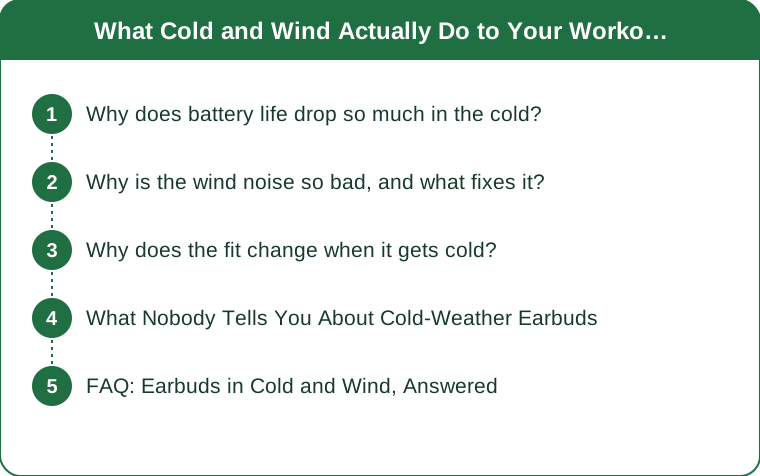
Why does battery life drop so much in the cold?
Chemistry, and it is temporary rather than permanent damage.
What happens inside the cell. Lithium-ion batteries rely on ion movement through an electrolyte. Cold increases the electrolyte’s viscosity and slows that movement, which raises internal resistance and reduces the current the battery can deliver.
The practical effect:
- Around 10 to 20 percent capacity loss near 0C is typical
- More in genuinely cold conditions, and the drop accelerates as temperature falls
- The battery gauge becomes unreliable, which is why earbuds sometimes report 40 percent and then die - the voltage sags under load and the device reads it as empty
It is a temporary effect. Bring the earbuds back to room temperature and the capacity returns. What does cause permanent damage is charging a battery below freezing, which can plate lithium onto the anode. Most modern devices refuse to charge when too cold, but leaving a case in a cold car overnight and then plugging it in is worth avoiding.
Practical mitigations:
- Keep the charging case in an inside pocket, close to your body, rather than in a bag or an outer pocket
- Start fully charged, since you have less usable capacity to work with
- Wear a headband or hat over the earbuds, which keeps them meaningfully warmer and is the single most effective step
- Do not leave earbuds in a car overnight in winter
A related and less obvious problem: condensation. Bringing very cold earbuds into a warm room causes moisture to condense on and inside them. Let them warm up before putting them in the case and closing it, since a sealed case traps the moisture against the electronics. This is a genuine cause of earbud failure and almost nobody knows about it.
Why is the wind noise so bad, and what fixes it?
Turbulence across the microphone ports, and the fixes are physical rather than digital.
The mechanism. Wind noise is not sound arriving from the environment. It is air turbulence created as wind flows across the microphone opening, generating pressure fluctuations directly at the sensor. That is why it overwhelms everything - it is being created at the microphone rather than picked up from a distance.
Why it affects some modes and not others:
- Music playback alone is largely unaffected, since microphones are not in the signal path
- Transparency or ambient mode is severely affected, because it feeds microphone input to your ears directly
- Active noise cancellation can be affected, since it uses external microphones and some designs handle wind badly
- Calls are worst of all, because the person on the other end hears the raw turbulence
What actually reduces it:
- A headband, buff or hat over the ears. The most effective single fix by a wide margin - it physically disrupts the airflow before it reaches the microphone port
- Turn off transparency mode in wind. Obvious once stated, and it transforms the experience
- Some earbuds have a wind reduction mode, which works to varying degrees
- Running with the wind behind you on the return leg, where a route allows the choice
- Bone conduction headphones, which sit outside the ear canal entirely and are considerably less wind-affected, at the cost of sound quality
What does not work: turning up the volume, which raises the total sound level without improving the ratio and adds hearing risk.
A safety note that matters more in autumn. Transparency mode is what lets you hear traffic, and wind is when you most want to turn it off. In low light with wind, running with one earbud out, or using bone conduction, is the more sensible arrangement - and low light plus reduced hearing is exactly the combination worth avoiding.

Why does the fit change when it gets cold?
Because ear tissue responds to temperature, and the seal is what holds the earbud in.
What happens physically. In cold conditions, peripheral vasoconstriction reduces blood flow to the extremities, including the ears. Tissue volume changes slightly, and the ear canal shape shifts marginally.
The consequence. An eartip that formed a good seal in a warm room forms a slightly looser one in cold air. A slightly looser seal means less friction holding the earbud, and it works loose during running.
Two secondary effects:
- Eartip material stiffens in the cold. Silicone becomes less pliable and conforms less well. Foam tips are affected more - they compress and expand more slowly when cold, which changes the insertion technique needed
- Bass response drops when the seal is imperfect, which is often the first sign that fit has changed. If your music sounds thin outdoors and full indoors, the seal is the reason
Fixes:
- Warm the eartips before inserting, by holding them in a closed hand for 20 seconds. Foam tips in particular need this
- Consider going one eartip size up for winter, which many people find necessary and few think to try
- A headband over the ears provides mechanical retention independent of the seal, and it solves this and the wind problem simultaneously
- Ear hooks or wing tips, which hold the earbud by shape rather than friction and are unaffected by the seal
On sweat, which does not stop in the cold. You sweat under a headband and hat even at low temperatures, and that moisture reaches the earbuds while the cold makes you less aware of it. Wipe them dry before casing them, particularly given the condensation issue described above. The combination of sweat and a temperature swing is harder on earbuds than either alone.
What Nobody Tells You About Cold-Weather Earbuds
The case protects less than you think. A charging case in an outer pocket is at ambient temperature within minutes, and it will then charge your earbuds slowly or refuse entirely. Inside pocket, always.
Condensation kills more earbuds than cold does. Cold earbuds into a warm room, then straight into a sealed case, traps moisture against the electronics. Let them sit out for ten minutes first - this is the most useful and least known tip here.
Touch controls become unusable with gloves. Capacitive controls need skin contact, and this is a genuine daily annoyance in autumn and winter. Earbuds with physical buttons are meaningfully better in the cold, and it is worth weighting that in a purchase decision if you train outdoors.
Battery percentage readings become unreliable rather than merely lower. Voltage sag under cold makes the gauge pessimistic and erratic. Do not plan a long session around a reading taken outdoors.
One earbud usually dies first, and cold exaggerates it. The primary earbud handles the connection to your phone and uses more power, and the gap widens when both are working harder. Swapping which one you use as primary, where the app allows it, evens the wear.
Bone conduction becomes more attractive in winter. No seal to lose, far less wind noise, works under a hat, and leaves your ears free to hear traffic in low light. The sound quality is worse and for autumn road running that is often the right trade.
FAQ: Earbuds in Cold and Wind, Answered
Why does my earbud battery die so fast in the cold?
Cold slows ion movement in lithium batteries and raises internal resistance, cutting usable capacity by roughly 10 to 30 percent. It is temporary and recovers at room temperature.
Does cold permanently damage earbuds?
Using them in the cold does not. Charging a battery below freezing can cause permanent damage, so avoid plugging in a case that has been left in a cold car.
What actually stops wind noise?
A headband, buff or hat over the ears, which disrupts the airflow before it reaches the microphone port. Turning off transparency mode also helps immediately.
Why do my earbuds fall out more in cold weather?
Cold changes ear tissue slightly and stiffens the eartips, so the seal loosens. Warm the tips in your hand before inserting, or try one size larger for winter.
Why does my music sound thin outdoors?
A compromised seal reduces bass response first. It is usually the earliest sign that the fit has changed, before the earbud actually works loose.
What is the most common cause of cold-weather earbud failure?
Condensation. Cold earbuds brought into a warm room and sealed straight into a case trap moisture against the electronics. Let them sit out for ten minutes first.
TL;DR:
- Cold cuts usable battery capacity 10 to 30 percent temporarily; keep the case in an inside pocket and start fully charged
- Never charge a case that has been sitting in freezing conditions - that is the one thing that causes permanent damage
- Wind noise is turbulence at the microphone port; a headband over the ears fixes it better than any software setting
- Cold changes ear tissue and stiffens eartips, so warm the tips before inserting or size up for winter
- Condensation from cold-to-warm transitions kills more earbuds than cold itself - let them dry before casing
A thin headband solves the wind, the fit and half the battery problem at once. It is the cheapest upgrade available.
Keep Reading
This article is for general informational and styling purposes only. Fit, sizing, and product availability may vary.