Sweat Is Killing Your Workout Earbuds - Here Is How to Slow It Down
Quick Answer: Sweat outdamages rain because it is salt water plus skin oils - it corrodes charging contacts, clogs speaker mesh, and creeps past seals that were tested against fresh water. The lifespan-doubling habits cost two minutes: wipe buds down after every sweaty session, let them air-dry ten minutes before casing them (the sealed case is where trapped sweat does its worst work), deep-clean tips and mesh weekly, and never leave the case in a hot car. Buying: IPX4 is the working minimum for heavy sweaters, and know that most warranties quietly exclude sweat damage.
Workout earbuds have a suspicious pattern: they work perfectly for eight or ten months, then the left one starts cutting out, or the case stops charging them, or the volume seems quieter than it used to be. It feels like planned obsolescence. It is usually salt. The sweatiest accessory you own is also the most delicate electronics you own, and the gap between a one-year lifespan and a three-year one is mostly maintenance nobody ever explains.

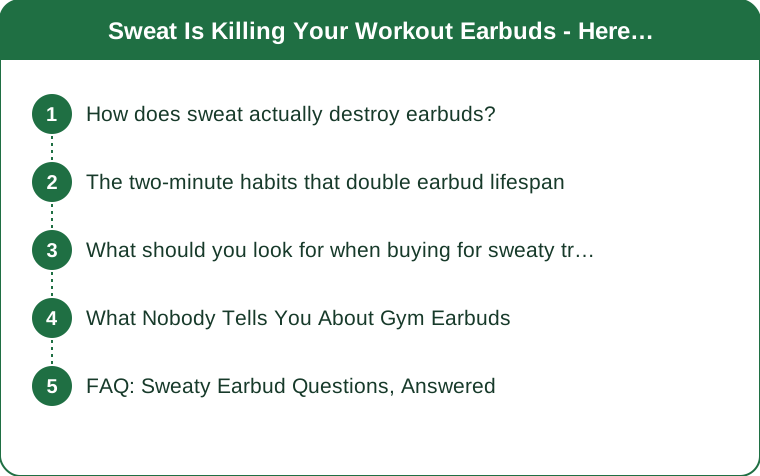
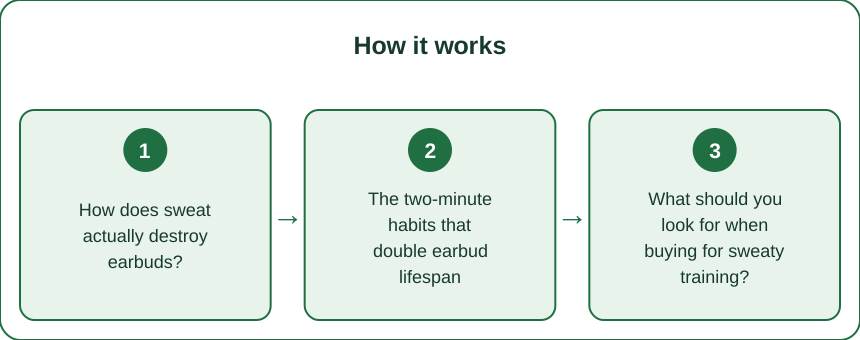
How does sweat actually destroy earbuds?
Three separate attack routes, all slow, all cumulative.
Sweat is corrosive in a way rain is not. It is salt water - with skin oils, lotion residue, and sunscreen mixed in. Salt water conducts electricity and corrodes metal aggressively: the exposed charging contacts on the buds and inside the case are the front line, growing an oxide film that starts as intermittent charging - the bud you have to reseat twice - and matures into a dead contact. The dried salt also stays behind after the water evaporates, so every session deposits another layer unless something removes it.
The acoustic mesh clogs like a filter - because it is one. The fine metal or fabric mesh protecting the speaker faces a slurry of sweat, skin oil, and earwax softened by workout heat. It accumulates gradually, muffling volume and thinning bass so slowly you adjust without noticing - the classic my-earbuds-got-quiet complaint is more often a clogged mesh than a dying battery. Left long enough, the residue hardens and becomes genuinely difficult to remove safely.
Seals age, and sweat exploits the aging. Water resistance comes from gaskets and adhesives that degrade with heat cycles, oils, and time - which is why the rating on the box describes the bud when new, not the bud at month ten. Oils in sweat and sunscreen are notably harder on seals and housings than plain water; the rating tests never included them.
And the charging case is an accomplice. A sweat-wet bud dropped straight into the sealed case brings moisture into a closed, warm box with the most delicate contacts in the system - then the lid shuts and the corrosion works overnight. The case also lives in the gym bag next to a hot car window, and lithium batteries aging fast in heat is its own quiet failure line. Most earbuds that die of sweat officially die in the case.
The two-minute habits that double earbud lifespan
None of this is fussy. It is the electronics equivalent of rinsing a swimsuit.
After every sweaty session: wipe, then wait. A quick pass with a dry or barely damp soft cloth over the whole bud - body, contacts, mesh area - removes the salt before it dries into a deposit. Then the ten-minute rule: buds sit out in open air before they go back in the case, long enough for surface moisture and the damp inside the mesh to evaporate. Pocket the case, carry the buds loose in a clean pocket of the gym bag, case them when you get home. This single sequencing change - dry before casing - is the highest-value habit on the list.
Weekly: the five-minute deep clean. Pull the silicone tips off and wash them alone in mild soapy water; they are the only fully washable part. Dry-brush the mesh gently with a soft toothbrush or the brush end of an electronics cleaning tool, angling the bud mesh-down so debris falls out rather than in. Wipe the charging contacts - bud and case - with a cotton swab barely dampened with isopropyl alcohol, which dissolves salt film and evaporates clean. Check the case’s charging ports for lint and grit while you are there.
Never: the hot car, the sauna, the shower. Heat accelerates every failure mode at once - battery aging, seal degradation, adhesive creep - and a dashboard case in August sails past component tolerances. Steam rooms and showers are the double feature: heat plus water vapor fine enough to slip seals that stop droplets. The workout survivor that dies anyway usually died in a parked car or a post-run shower, not the workout.
For heavy sweaters: rotate two pairs. The same logic as running shoes - a rest day lets each pair fully dry internally, and salt exposure per pair halves. One premium pair plus one modest backup covers the schedule for less than replacing the premium pair a year early would cost.
And mind the sunscreen hand. Applying sunscreen then immediately handling buds coats them in the oils seals like least - order of operations: sunscreen, hands wiped, then earbuds.

What should you look for when buying for sweaty training?
The spec sheet tells you some of it; the design tells you the rest.
Decode the IP ratings honestly. IPX4 means splash-resistant from any direction - the working minimum for real training, adequate for typical gym sessions. IPX5 to 6 means resistance to water jets: better margin for drenching sweaters and rain runners. IPX7 means survival of temporary immersion in fresh water - reassuring, with the caveat everyone misses: the tests use fresh water, so no rating is a promise about salt, oil, or a thousand repetitions of sweat-and-dry. The rating is a floor for accidents, not a maintenance exemption - and an X in the first position simply means dust protection went untested, not that it failed.
Prefer designs that shed rather than pool. Sweat obeys gravity: buds with smooth, downward-shedding housings and minimal crevices around the mesh do measurably better than sculpted designs with ledges where drops sit. Wing-tip and over-ear-hook designs add security but create contact lines where sweat holds against the housing - fine with the wipe-down habit, worse without it.
Replaceable tips and a serviceable mesh. Silicone tips in multiple sizes are hygiene consumables - buy models where spares are cheap and standard. A mesh protected by a removable tip is easier to keep clear than one recessed in the housing.
Read the warranty for the sweat clause. Most manufacturer warranties cover defects and exclude liquid damage - which, for a product marketed with sweat-splashed athletes, is a quietly bold position. A few sport-focused brands offer genuine sweat-and-water coverage or one-time replacement programs, and that policy difference is worth real money at month nine. Check before buying, not after failing.
Budget logic for heavy sweaters: a mid-price pair with IPX5-plus, cheap replacement tips, and honest warranty terms - maintained well - beats a flagship pair treated carelessly on total cost every time. Sweat does not read spec sheets; it reads habits.
What Nobody Tells You About Gym Earbuds
The left-first death is usually habits, not luck. Ask around and one side dying first is near-universal - and the culprit is rarely the hardware lottery. One bud gets handled with the sweaty dominant hand, sits in the case slot nearer an old spill, or takes the phone-call solo duty and extra pocket time. The buds share a birthday but not a biography - the wipe-down habit equalizes them.
The volume creep you blame on hearing is usually the mesh. Six months of gradual clog, six months of nudging volume up two notches to compensate - then a proper mesh cleaning restores the sound and you realize you have been compensating for sediment. Worth knowing before concluding your ears or the batteries aged: it is the filter, and the filter cleans.
The gym bag is a microclimate. Sealed with damp kit, parked in heat, the bag interior runs humid for hours - and the earbud case marinates in it. The fix costs nothing: the case rides in an outer mesh pocket, or better, in your jacket, and never overnights in the bag with wet clothes.
Toothpicks have ended more earbuds than swimming pools. The visible mesh gunk invites excavation, and a metal pin or wooden pick through the mesh is instant, unrepairable damage. Soft brush, dry, gentle, mesh facing down - nothing that pierces, ever. If brushing cannot clear it, isopropyl on a swab touched to the mesh edge is the last safe escalation.
Bone-conduction sidesteps the whole war. Open-ear bone-conduction headsets keep the driver out of the sweat-and-wax canal entirely, and for the heaviest sweaters - or anyone whose ears protest silicone in summer - they trade some bass for a maintenance load near zero and situational awareness on outdoor runs as a bonus.
FAQ: Sweaty Earbud Questions, Answered
Is IPX4 enough for heavy sweating?
It is the honest minimum: enough for regular training with good habits, since sweat exposure resembles persistent splashing. Drenching sweaters, hot-yoga regulars, and rain runners get real margin from IPX5 to 7 - but remember the rating describes a new unit against fresh water. The wipe-and-dry routine protects any rating better than a higher rating protects a neglected pair.
Can rice save sweat-soaked earbuds?
Rice is theater - it absorbs vapor slowly and adds dust to your problem. What works: wipe them down, leave buds and open case in moving room-temperature air for 24 to 48 hours, and resist charging until fully dry, since charging a wet contact accelerates corrosion. If they were truly saturated, a swab of isopropyl on the contacts after drying addresses the salt left behind.
Why do my earbuds sound muffled after a few months?
Almost always the acoustic mesh clogging with sweat residue and softened earwax rather than driver failure. The weekly dry-brush plus clean tips restores most of it; long-neglected mesh may need several gentle sessions. If cleaning changes nothing and one side is quiet, then you are into genuine hardware territory - but clean first, conclude second.
Should I take earbuds out between sets to let them dry?
No need - mid-workout removal mostly adds drop risk and sweaty handling. The moisture that matters is what goes into the sealed case afterward, so spend the effort where it counts: the post-session wipe and the ten open-air minutes before casing. That is the whole game, and it fits inside your cool-down.
TL;DR:
- Sweat is salt water plus oils - it corrodes contacts, clogs mesh, and defeats seals rain never would.
- The sequence that saves them: wipe after every session, air-dry ten minutes, then case - never wet into the sealed box.
- Weekly: wash tips, dry-brush mesh face-down, isopropyl swab on contacts.
- Heat is the accomplice - no hot cars, no saunas, no gym-bag overnights with damp kit.
- Buy IPX4 minimum, prefer shedding designs and cheap spare tips, and read the warranty’s liquid clause before you need it.
Earbuds do not die at the gym - they die in the case, of neglect, a few milligrams of salt at a time. Two minutes of drying and a weekly brush is the entire difference between replacing them yearly and forgetting how old they are.
Keep Reading
This article is for general informational and styling purposes only. Fit, sizing, and product availability may vary.