Workout Earbuds Under a Beanie and Hood: What Actually Stays In
Quick Answer: Beanies and hoods cause three specific earbud problems: pressure that slowly pushes a bud out of position, accidental touch-control triggers through the fabric, and wind noise amplified by a hood flapping around the microphone. The styles that handle it best are ear-hook designs and open-ear bone-conduction or air-conduction buds. Standard stemless in-ear buds are the worst fit for winter layers - they are exactly what a beanie edge catches.
This is one of those problems that seems trivial until it happens at mile three in 35F with gloves on.
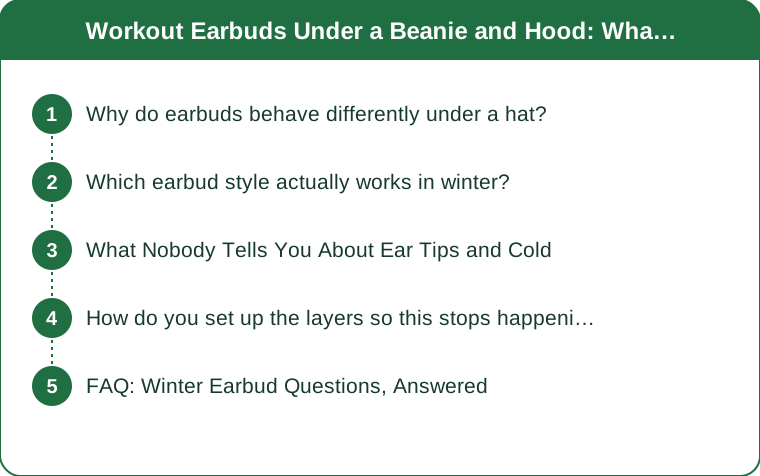
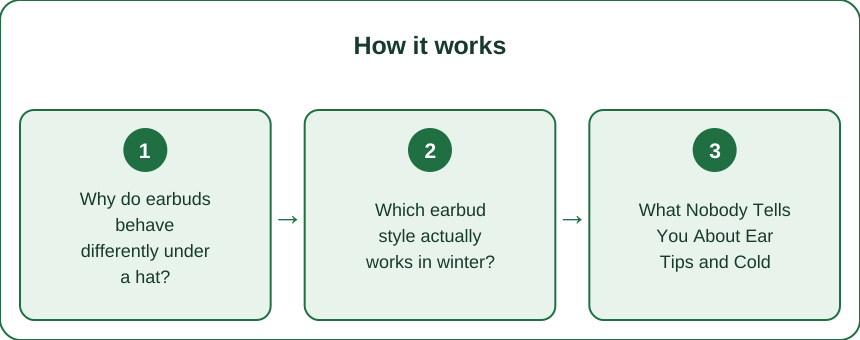
Why do earbuds behave differently under a hat?
Four mechanisms, and they compound.
Direct pressure. A snug beanie presses on the outer ear and the bud itself. Over 20-30 minutes of jaw movement and head motion, that pressure slowly rotates the bud out of its seated position. You do not notice it happening - you notice that the bass has vanished, which is the seal breaking, and then the bud falls.
Fabric on the touch surface. Most modern buds use capacitive or pressure-sensitive touch controls on the outer face. A beanie sitting against that surface produces phantom taps - tracks skipping, calls answered, noise cancellation cycling - and you cannot easily tell which touch was you.
The hood is a wind tunnel. A hood that is not cinched creates turbulent air around your ears and directly over the microphones. This makes outbound calls nearly unusable and, on buds with transparency mode, produces a loud roar.
Cold changes the materials. Silicone ear tips get firmer below about 40F, which reduces how well they conform to the ear canal and degrades the seal. Battery performance also drops in the cold - most lithium batteries lose noticeable runtime below freezing, so a bud that lasts six hours in summer may give you four in January.
So it is not that your earbuds got worse. Your ears are now inside a compression system.
Which earbud style actually works in winter?
Ear-hook designs are the most reliable. A hook that wraps over the top of the ear provides mechanical retention independent of the ear canal seal, so beanie pressure cannot dislodge them. The hook also sits under the beanie edge rather than at it. The trade-off is bulk, which can be uncomfortable under a very tight hat.
Open-ear designs - bone conduction or air-conduction buds that sit in front of the ear rather than in it - are the other strong answer. Nothing to fall out, no seal to break, and a substantial safety advantage outdoors: you hear traffic. The trade-offs are weaker bass and audible sound leakage, both of which matter less outdoors than in.
Standard stemless in-ear buds are the worst option here. They are small, they rely entirely on the canal seal, and their entire outer surface is a touch control sitting directly against fabric.
Stemmed in-ear buds are middling. The stem gives you something to grip with gloves on and moves the touch surface slightly away from the beanie edge, but the retention still depends on the seal.
Over-ear headphones deserve a mention: in genuinely cold weather they are warm, they stay put, and they have physical buttons that work with gloves. For walking and outdoor cardio in deep winter, they are underrated. They are hopeless once you sweat.

What Nobody Tells You About Ear Tips and Cold
The ear tip is the component that determines almost everything, and almost nobody changes theirs.
Silicone stiffens in the cold. Standard silicone tips become measurably firmer below about 40F. A firmer tip conforms less well to the ear canal, which is why buds that seal perfectly indoors leak on a cold morning. The fix is switching to memory foam tips, which soften with body heat once inserted and maintain the seal far better in cold conditions. Foam tips are cheap and they are the single highest-value upgrade for winter earbud use.
Tip size probably needs to change too. Most people use the size that came pre-installed, which is the middle size, which fits maybe half of ears. Ear canals are commonly different sizes left and right - it is entirely normal to need a medium on one side and a large on the other, and most tip kits give you enough to mix.
The seal test: put both buds in and play music, then press each bud gently inward. If the bass increases noticeably, your seal is inadequate and you need a bigger tip or foam.
Condensation is the winter failure mode nobody expects. Moving from cold outdoor air into a warm building causes condensation to form on and inside the buds - the same thing that fogs glasses. Over a season this is a real cause of failure. Let them sit out for ten minutes before putting them in the charging case, and never put damp buds into a sealed case.
And the hygiene note: wax buildup increases in winter for most people, and it degrades both sound and seal. Clean the mesh with a dry soft brush weekly.
How do you set up the layers so this stops happening?
Order of operations: buds first, then beanie, then hood. Obvious, and people reverse it constantly by pulling the hat down after adjusting a bud, which shifts it.
Choose a beanie with a wider band or a looser fit at the ear. A very tight ribbed hat concentrates pressure exactly on the bud. A slouchy or fleece-band hat distributes it. Some running-specific hats have a slightly relieved area at the ears for precisely this.
A headband instead of a hat. For temperatures in the 40s and 50s, an ear-warmer headband that covers the ears without a crown is warmer than expected and puts far less pressure on a bud than a full hat.
Cinch the hood or skip it. An uncinched hood is the single biggest source of wind noise. If it is not cold enough to justify cinching, it is not cold enough to need the hood.
Disable touch controls before the run. Most apps allow turning off tap detection entirely. If your buds skip tracks every time you adjust your hat, this one setting solves it permanently and you can use your phone or watch for control.
Keep the case in an inside pocket. A charging case in an outer pocket in freezing weather charges slowly or not at all - most cases will not charge below freezing. Body heat in an inside pocket keeps it functional.
And use one bud for road safety. In low light and cold, with a hood restricting peripheral vision, running with both ears sealed on a road is a genuine risk. One bud, or open-ear, is the sensible call.
FAQ: Winter Earbud Questions, Answered
Do earbuds actually break in the cold?
Extended exposure below freezing can affect battery performance and, over time, seals and adhesives. Most damage attributed to cold is actually condensation damage from the temperature transition rather than the cold itself. Let them warm up before casing them.
Are bone conduction buds worth it for winter running?
For outdoor running specifically, they solve the retention problem, the beanie pressure problem, and the road safety problem at once. Sound quality is objectively worse. Most people who run outdoors regularly in winter consider that a good trade.
Why does my battery die so much faster in winter?
Lithium batteries lose capacity in the cold - a noticeable drop below freezing is normal and largely reverses when they warm up. Keeping the case in an inside pocket and the buds in your ears (where body heat helps) both mitigate it.
How do I use controls with gloves on?
Capacitive touch controls generally do not work through gloves unless the gloves are touchscreen-compatible, and even then reliability is poor. Buds with physical buttons, or controlling from a watch, are the practical answers. This is a good argument for setting up your playlist before you leave.
TL;DR:
- Beanies cause slow bud rotation, phantom touch taps, and wind noise - not just the obvious falling-out problem.
- Ear-hook or open-ear designs handle layers best; stemless in-ear buds handle them worst.
- Switch to memory foam tips for winter - silicone stiffens in the cold and the seal goes with it.
- Buds first, then hat, then hood, turn off touch controls, and keep the case in an inside pocket.
Most of this is a five-minute setup change rather than a new purchase. Do it before the first properly cold run rather than during it.
Keep Reading
This article is for general informational and styling purposes only. Fit, sizing, and product availability may vary.