The BPM Effect: Building Workout Playlists That Actually Push You
Quick Answer: Music measurably lowers perceived effort and can extend endurance, and tempo is the active ingredient. Match BPM to the activity: 120–130 for walking, 150–170 for running (matching stride rate), 130–150 for lifting, under 100 for cooldowns. Place your strongest tracks where workouts sag, rotate about a quarter of the playlist monthly, and keep one emergency anthem you never play casually.
Sports scientists have confirmed what every gym-goer already knows at 6am: the right song is a legal stimulant.
Music lowers your rating of perceived exertion, steadies your pace, and extends how long you’ll keep going — measurably, in controlled studies. Which means playlist-building isn’t entertainment. It’s training design.

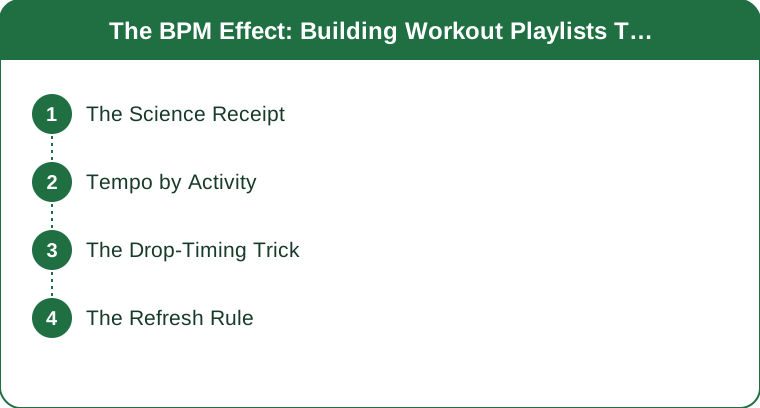
Does music actually improve workouts?
Yes, and the effect is more specific than “it’s motivating.”
It lowers perceived exertion. Research on synchronized music consistently shows meaningful reductions in how hard the same effort feels. Your brain has limited attentional bandwidth, and rhythm occupies some of it — so the suffering gets under-reported.
It extends time to exhaustion. In endurance testing, participants working with tempo-matched music tend to last longer at the same intensity.
It stabilizes pace. Synchronizing your stride to a steady tempo removes the unconscious drift that makes people go out too fast and fade.
The limit worth knowing: the effect is strongest at low-to-moderate intensities. Near maximum effort, physiological signals overwhelm everything and the music matters less. So the playlist is most valuable exactly where most of your training volume lives.
Think of it less as entertainment and more as analgesic scheduling — you’re deciding in advance where the pain relief goes.
What BPM should you use for each activity?
Walking: 120–130 BPM. This matches a comfortable brisk cadence. Most pop sits here naturally, which is why walking playlists are the easiest to build.
Running: 150–170 BPM. The target is your stride rate. Most efficient runners land somewhere between 165 and 180 steps per minute, and a song at 170 BPM synchronizes one footfall per beat. A track at 85 BPM works too — that’s one footfall every half-beat, which feels identical.
Lifting: 130–150 BPM, but with a caveat — attitude matters more than tempo here. You’re not synchronizing to a beat during a heavy set; you’re using the track for arousal. A slow, heavy song can outperform a fast, light one.
HIIT and intervals: match the work period, not the whole session. A 140+ BPM track for the work block, something calmer for the rest block.
Cooldown: under 100 BPM. Deliberately down-shifting the tempo helps heart rate come down and marks the session as finished.
Practical tip: most streaming services and several free web tools will tell you a track’s BPM. Build zones rather than vibes — a “running” playlist with tracks ranging from 95 to 175 BPM isn’t a zone, it’s a shuffle.

Where should the best songs go?
This is the tactical part, and almost nobody does it deliberately.
Map where your workouts sag. For most runs, that’s the middle third. For intervals, it’s rounds 4 through 6. For a lifting session, it’s the third exercise. Those are your placement targets.
Put your most electric tracks there, not at the start. The first ten minutes don’t need help — you’re fresh and the novelty is doing the work. Front-loading your best songs means spending your best ammunition on the easiest part.
Time a drop to a known hill. If you run the same route, you know where the climb is. Some runners genuinely sequence a specific drop to hit at the base of it, and it works.
Give the cooldown its own tracks. Ending a session on a 165 BPM banger keeps you wired. A deliberate down-shift closes the loop.
Music as tactical reserve, deployed exactly where willpower thins.
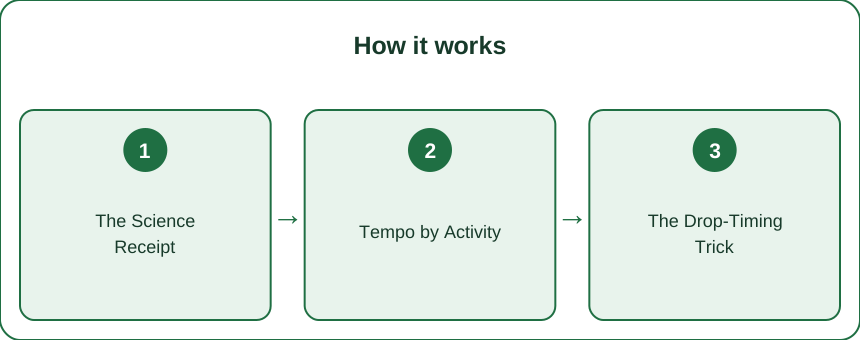
Myth vs Fact
Myth: Faster music is always better. Fact: Only up to a point, and only when it matches your actual movement rate. Music substantially faster than your cadence creates a mismatch that some people find agitating rather than motivating.
Myth: You have to like the song for it to work. Fact: Preference helps a lot, but tempo produces measurable effects even with music you’re neutral about. That said, a song you love at slightly the wrong BPM usually beats a song you’re indifferent to at exactly the right one.
Myth: Lyrics don’t matter. Fact: Motivational lyrical content has its own documented effect, separate from tempo. It’s why certain training anthems outperform their BPM.
Myth: Podcasts are just as good. Fact: Not for pacing or exertion, because there’s no rhythm to synchronize to. Podcasts are excellent for easy long efforts and mediocre for anything you want to pace precisely.
Myth: A great playlist lasts forever. Fact: The 30th play of a song moves almost nothing. Habituation is real and it’s fast.
How often should you refresh a workout playlist?
Rotate about 25% monthly. Enough novelty to keep the effect alive, enough continuity that you’re not rebuilding from scratch every four weeks.
Keep two or three permanent anthems. Played consistently in the same context, these become genuine conditioned triggers — the first bar produces the response before you’ve thought about it.
Protect one emergency song. Never play it casually. Save it for the last interval, the final kilometer, the set you weren’t sure you had. Scarcity is what keeps the magic in it, and burning it on a Tuesday warm-up wastes a real asset.
Rebuild seasonally. Every three months or so, dump anything you’ve been skipping. Skipped songs are dead weight — they interrupt the rhythm you built the playlist to create.
And check your volume. Sustained loud listening through earbuds carries real hearing risk. If you can’t hear traffic or someone talking to you at arm’s length, it’s too loud — and outdoors, situational awareness matters more than the drop.
FAQ
What BPM is best for running?
150 to 170 BPM for most runners, matching your stride rate at one footfall per beat. If you don’t know your cadence, count your right footfalls for 30 seconds, double it, then double again.
Does music help with lifting?
Yes, mostly through arousal rather than synchronization. Tempo matters less than intensity and attitude — pick tracks that make you want to pick heavy things up, not tracks that match a rep speed.
Should I use music for easy recovery runs?
Podcasts or nothing often work better for easy days, since the whole point is staying genuinely easy — and tempo music tends to pull your pace up without you noticing.
TL;DR:
- Music lowers perceived effort and extends endurance — strongest at low-to-moderate intensity.
- BPM by activity: walking 120–130, running 150–170, lifting 130–150, cooldown under 100.
- Put your best tracks where workouts sag (middle third, rounds 4–6), not at the start.
- Rotate ~25% monthly, keep 2–3 conditioned anthems, protect one emergency song.
- Watch the volume — if you can’t hear someone at arm’s length, it’s too loud.
Keep Reading
This article is for general informational and styling purposes only. Fit, sizing, and product availability may vary.